MGO and UMF: What Manuka Honey Activity Ratings Actually Measure
Walk into any chemist in Sydney or Auckland and you will see manuka honey labelled MGO 100, MGO 250, MGO 400+, UMF 5+, UMF 10+, UMF 20+ — at prices ranging from AUD 30 to AUD 400 a jar. The ratings are not marketing fluff; they are quantitative chemistry. Here is exactly what each number measures, and how to choose what you actually need.
Manuka honey is honey produced by European honey bees foraging on the manuka tree (Leptospermum scoparium), native to New Zealand and parts of southeast Australia. What makes it commercially valuable is not the sugar content — that is similar to all honey — but a single small molecule called methylglyoxal (MGO) which manuka honey contains in concentrations 100 to 1,000 times higher than ordinary honey. MGO is the source of manuka's well-documented antibacterial activity.
The two rating systems
MGO (methylglyoxal) — the direct measurement
MGO is a number expressed in milligrams of methylglyoxal per kilogram of honey (mg/kg). It is measured directly in the laboratory by HPLC. A label of MGO 250 means 250 mg of methylglyoxal per kg of honey. MGO 850 means 850 mg/kg. The number scales linearly with antibacterial potency — MGO 250 is roughly half the antibacterial activity of MGO 500.
MGO is the rating system used most commonly by Australian and many international producers, and the simplest to understand: it is the chemistry, with no conversion needed.
UMF (Unique Manuka Factor) — the New Zealand certification scheme
UMF is a trademark and certification programme run by the Unique Manuka Factor Honey Association in New Zealand. A UMF rating tests for four markers: MGO (antibacterial), DHA (the precursor to MGO that converts over time, indicating freshness potential), leptosperin (a manuka authenticity marker), and HMF (a freshness marker — high HMF indicates heat damage or age). UMF certification therefore proves both potency AND authenticity AND quality.
The UMF number itself is benchmarked against the antibacterial activity of phenol — UMF 10+ honey has antibacterial activity equivalent to a 10% phenol solution. Higher UMF means higher activity.
Conversion table
| UMF | MGO (mg/kg) | Activity tier | Typical use |
|---|---|---|---|
| 5+ | 83+ | Daily wellness | Tea, breakfast, mild support |
| 10+ | 263+ | Active | Sore throat, occasional immune support |
| 15+ | 514+ | Strong | Targeted use, skincare formulations |
| 20+ | 829+ | High strength | Wound care (under medical advice), premium skincare |
| 24+ | 1122+ | Maximum certified | Specialised therapeutic use |
Approximate conversion: MGO ≈ (UMF − 2) × 50. UMF 10+ ≈ MGO 400. The exact relationship is non-linear at the very high end.
How to choose what you actually need
For everyday food use
MGO 100–250 (UMF 5+ to 10+) is plenty. Higher grades have minimal extra benefit when consumed as honey on toast, and the price premium is significant. The flavour gets stronger and more medicinal as MGO climbs.
For everyday use as a stronger-flavoured table honey
MGO 250–550 (UMF 10+ to 16+) is a common pick if you want something more characterful than commodity honey. Avoid heating above 60 °C — heat degrades MGO. This is general culinary information, not medical advice; for any health concern, consult a qualified healthcare professional.
For skincare formulations
Skincare formulators commonly select MGO 400–550 (UMF 13+ to 16+) for finished products at 5–10% inclusion, balancing functional ingredient profile and cost. Higher MGO honey is generally not necessary in wash-off products because contact time is short.
Medical-grade products are a separate category
Manuka-based wound dressings used in clinical settings are registered therapeutic goods (regulated in Australia by the TGA) and are processed and dosed under medical supervision. They are not equivalent to consumer table or skincare honey, and should not be self-applied to serious wounds. For any wound care decision, consult a qualified healthcare professional.
Common pitfalls when buying manuka honey
- "Active manuka honey" with no MGO or UMF number on the label means nothing. Walk away.
- Total Activity (TA) ratings — measured with peroxide present — are not specific to manuka. Manuka's value is non-peroxide activity, which is what MGO captures.
- "Manuka blend" honey is a blend of manuka with cheaper honeys. The MGO will be diluted proportionally. Read the small print.
- A UMF certificate must show the licensee number and a current expiry. Old certificates from companies no longer in the program are not valid.
- Check the harvest year. MGO continues to convert from DHA over the first 6–12 months, and a fresher honey actually gains potency for a while; very old honey (3+ years) starts losing it.
How activity affects price
A rough international retail benchmark per 250 g jar:
| Grade | Approximate retail (AUD, 250 g) |
|---|---|
| MGO 100 | 25–35 |
| MGO 250 | 40–60 |
| MGO 400 | 70–110 |
| MGO 550 | 110–160 |
| MGO 850 | 180–280 |
| MGO 1200 | 300–500 |
Prices vary significantly by retailer and brand reputation — these are order-of-magnitude figures.
How it shows up in our portfolio
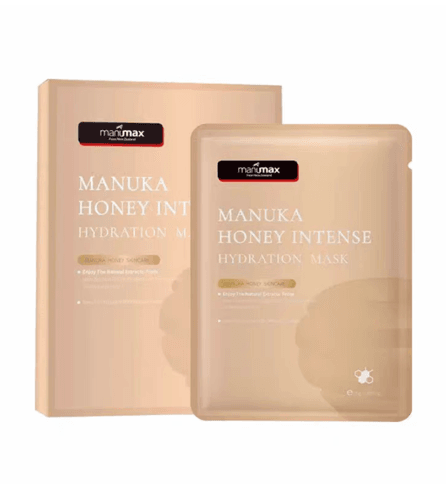
The Manumax range we carry uses MGO-active manuka honey across all SKUs. The Ice Soothing Spray, Shower Gel and Sheet Mask formulations target the MGO 400–550 range — high enough for meaningful antibacterial benefit at the inclusion rate used in cosmetic formulations, while keeping price points accessible. Manumax operates from New Zealand, which gives them direct access to UMFHA-certified raw honey supply.
References
Written by the Sourcing & quality team — XYX Holdings Pty Ltd. Oceania Smart Select is the Australian product curation brand of XYX Holdings Pty Ltd (ABN 21 632 303 685). All claims are sourced from publicly verifiable industry standards or our own production specifications. Corrections or comments: contact us.
This article is published for general education and reflects information available at the time of writing. It is not medical, dietary, financial, or legal advice. Industry standards, product specifications, and regulations change over time — for decisions that affect your health, business, or compliance, consult a qualified professional and verify with the original authoritative sources we cite. We update articles when we notice material changes, but make no warranty of real-time accuracy.