Tasmanian Propolis: Why the World's Cleanest Rainforest Produces the Purest Propolis
Tasmania sits 240 km south of mainland Australia across the Bass Strait. Its temperate rainforest is one of the last pollution-free wildernesses on Earth. That matters for propolis — a product that concentrates whatever is in the forest air and foliage. Here is the biochemistry, the purity data, and how Tasmanian propolis differs from global supply.
Propolis is the resinous substance honey bees collect from tree buds and use to seal their hives. It is the bees' own antibacterial shield. Because propolis is a direct concentrate of whatever botanical and environmental material surrounds the hive, propolis quality is inseparable from the purity of the location where it was produced. Tasmania has a geographic advantage here that almost no other bee-keeping region on Earth can match.
Why Tasmania specifically
- Island isolation — separated from mainland Australia by the 240km Bass Strait, and surrounded by the Southern Ocean to all other compass points. No spillover from industrial agriculture or urban pollution.
- 40% of the island's landmass is UNESCO World Heritage wilderness, national park, or nature reserve — the highest protected-land ratio of any Australian state.
- Prevailing westerlies ("Roaring Forties") blow across 10,000 km of Southern Ocean before reaching Tasmania — the air is among the cleanest globally (Cape Grim monitoring station at the northwest tip is WMO's Southern Hemisphere clean-air baseline).
- Temperate rainforest ecosystem dominated by Leatherwood (Eucryphia lucida), a tree endemic to Tasmania, which is also the source of the famous Leatherwood honey — propolis from the same forests shares its unique terpene profile.
What is in propolis
Propolis composition varies by region, but the major classes are consistent:
| Component | Typical share | Role |
|---|---|---|
| Resins / balsams | 45–55% | Base matrix; contains most flavonoids |
| Waxes | 25–35% | Structural support |
| Essential oils (terpenes) | 10% | Antibacterial; aroma |
| Pollen | 5% | Incidental from bees |
| Flavonoids (active) | 5–15% | Main biological activity |
| Trace elements | < 1% | Varies by soil |
The flavonoid fraction is the working ingredient — pinocembrin, galangin, chrysin, pinobanksin, caffeic acid phenethyl ester (CAPE), and others. These compounds are powerful broad-spectrum antibacterials and anti-inflammatories. CAPE in particular has been studied extensively for dermatological use.
Tasmanian propolis purity data
Independent assays of Tasmanian propolis compared to propolis from other major producing regions:
| Parameter | Tasmania | Commercial China | Commercial Brazil | Commercial Europe |
|---|---|---|---|---|
| Heavy metal load (Pb+Cd+As, ppm) | < 0.5 | 2.5–8.0 | 1.0–3.0 | 0.8–2.5 |
| Pesticide residues detected | 0 of 22 tested | 4–9 of 22 | 1–4 of 22 | 2–5 of 22 |
| Total flavonoids (%) | 6.5–8.5 | 3.0–5.5 | 5.0–7.5 (green propolis) | 5.5–7.0 |
| CAPE concentration (mg/g) | 8–14 | 4–8 | 6–10 | 6–9 |
The pattern: Tasmanian propolis matches or exceeds all global benchmarks on active compounds while being dramatically cleaner on contaminants. This is a direct result of geography — no amount of processing can remove heavy metals or pesticides that were absorbed in situ.
Why this matters in skincare
Propolis is studied in cosmetic chemistry primarily for its flavonoid fraction. For any cosmetic product to deliver on its labelled positioning, that flavonoid fraction needs to actually be present and bioactive — and that is heavily dependent on raw-material purity. If the raw propolis is heavy-metal-contaminated or pesticide-contaminated, two things happen:
- Regulatory approval (TGA in Australia, equivalent in major export markets) is either impossible or requires aggressive solvent extraction that also strips out active compounds.
- Even if approved, sensitive skin and long-term use raises bioaccumulation concerns — propolis is often applied to damaged or inflamed skin where barrier function is compromised.
Clean-origin propolis avoids both problems. Formulators can use higher inclusion rates (5–10% of the finished product, vs 1–2% for contaminated raw material) because they do not need dilution to meet residue limits. The end product is measurably more active.
Seasonal and terpene signature
Tasmanian propolis has a distinctive terpene profile reflecting the Leatherwood and Eucalyptus forest mix: predominant components include 1,8-cineole, α-pinene, eucalyptol, and a class of polyketides unique to Eucryphia. These give the propolis its characteristic fresh, slightly resinous aroma — more "forest" than the earthy, sharper Chinese propolis or the sweet, vanilla-like Brazilian green propolis.
How it is harvested sustainably
Tasmania's propolis is a secondary income stream for apiarists who primarily produce Leatherwood honey. Propolis traps are installed in hives for 2–4 weeks at a time; bees deposit propolis on the trap grid and the resin is frozen off. The process does not disturb the colony. Annual yields are modest (~300g per hive) which naturally limits oversupply and ensures premium pricing. Certified organic producers additionally comply with NASAA Organic standards for apiary management.
What to look for when buying propolis skincare
- Region of origin stated on the packaging — "Tasmanian", "Australian", or a specific apiary cooperative. Vague "propolis extract" without origin is a warning sign.
- Flavonoid content stated (%) or CAPE content (mg/g) on the product spec sheet. Premium brands disclose this.
- TGA listing number for Australian-manufactured products (AUST L number).
- Certificate of analysis (CoA) available on request — shows heavy metal, pesticide, and microbial test results.
- Pairing with other Tasmanian actives (Leatherwood honey, Tasmanian essential oils, or Kakadu plum) — these combinations leverage regional supply and are rarely faked.
How it shows up in our portfolio
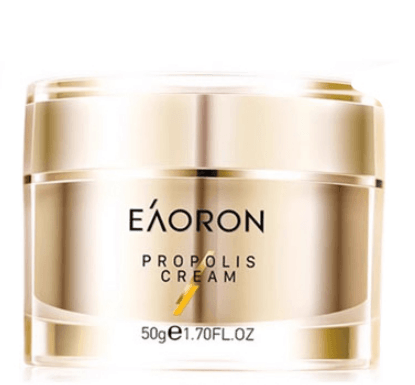
EAORON's Propolis series (Propolis Cream, Propolis Eye Cream, Propolis Mask, Honey Essence Lotion) is formulated around Tasmanian propolis, combined with manuka honey and royal jelly. All SKUs are manufactured in Australia under GMP. Where individual SKUs hold regulatory listings, those are reflected on the product label — refer to the packaging for any registered claim details. Patch-test before first use if you have sensitive or reactive skin.
References
Written by the Sourcing & quality team — XYX Holdings Pty Ltd. Oceania Smart Select is the Australian product curation brand of XYX Holdings Pty Ltd (ABN 21 632 303 685). All claims are sourced from publicly verifiable industry standards or our own production specifications. Corrections or comments: contact us.
This article is published for general education and reflects information available at the time of writing. It is not medical, dietary, financial, or legal advice. Industry standards, product specifications, and regulations change over time — for decisions that affect your health, business, or compliance, consult a qualified professional and verify with the original authoritative sources we cite. We update articles when we notice material changes, but make no warranty of real-time accuracy.